
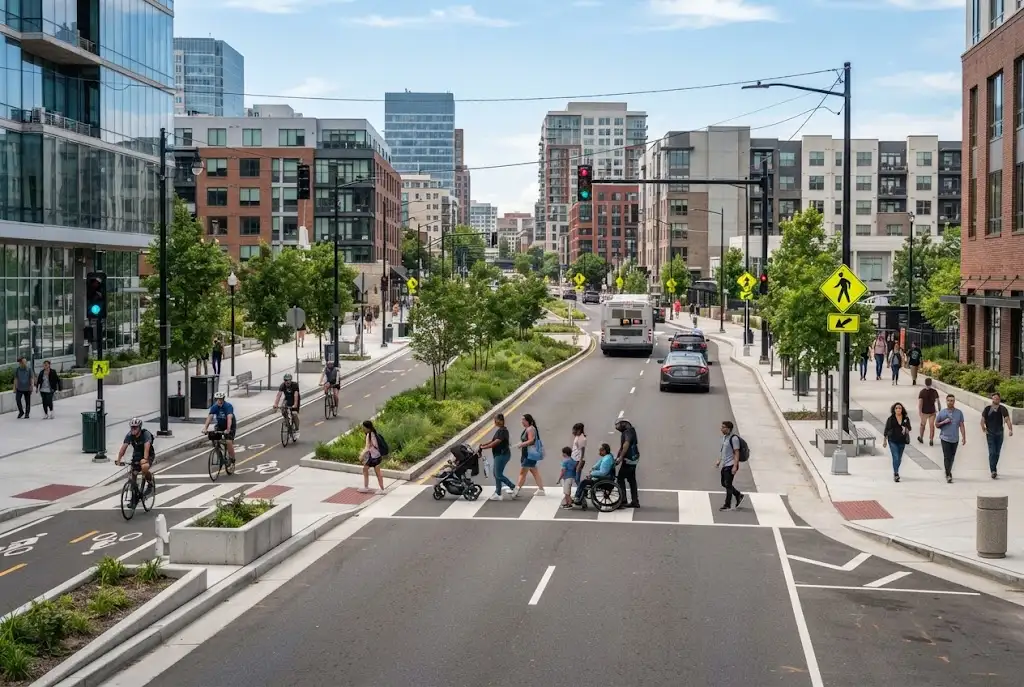
Urban road safety should be a fundamental consideration whenever cities plan, redesign, or expand their transportation networks. Roads connect neighborhoods, businesses, schools, transit systems, and public spaces, but poorly designed streets can create unnecessary risks for drivers, pedestrians, cyclists, and other road users.
Safe city roads require more than smooth pavement and clearly painted lanes. Effective urban road design considers how people actually move through a city, including walking, cycling, driving, using public transportation, crossing intersections, and accessing businesses and public facilities.
By combining thoughtful street design, appropriate traffic controls, accessible infrastructure, lighting, traffic-calming measures, and ongoing safety analysis, metropolitan areas can create transportation networks that better protect everyone who uses them.
Why Urban Road Safety Matters
City streets are shared spaces used by people with very different transportation needs. Drivers may be focused on traffic flow, while pedestrians need safe crossing points and cyclists require predictable space away from faster-moving vehicles.
The Federal Highway Administration identifies intersections, roadway departures, and crashes involving pedestrians and bicyclists as important areas for roadway safety improvements. Local governments also play a major role in planning and designing sidewalks, bike lanes, roads, and other urban transportation infrastructure.
That means safety should be considered from the earliest stages of transportation planning rather than added only after a serious problem occurs.
1. Design Roads Around All Road Users
A safe metropolitan road should account for more than motor vehicles. Pedestrians, cyclists, people with disabilities, public transportation users, delivery vehicles, and emergency responders all depend on the same transportation network.
Road design should therefore consider how different users interact with one another. Separating incompatible movements where appropriate and making interactions more predictable can reduce confusion and improve safety.
- Provide safe pedestrian routes.
- Make crossings visible and understandable.
- Provide suitable space for cyclists where cycling is supported.
- Design accessible routes for people with mobility challenges.
- Consider public transportation stops and passenger access.
- Maintain clear routes for emergency vehicles.
2. Build Better Sidewalks
Sidewalks are one of the most basic elements of pedestrian infrastructure, yet their quality can vary significantly from one neighborhood to another. A sidewalk should provide a practical and continuous route rather than forcing pedestrians into the roadway or around unnecessary obstacles.
Cities should consider sidewalk width, surface condition, drainage, crossings, curb ramps, lighting, and connections to nearby destinations when planning pedestrian infrastructure.
A well-connected sidewalk network is especially important around schools, transit stops, shopping districts, parks, healthcare facilities, and other areas where pedestrian activity is common.
3. Make Crosswalks Safer
Crosswalks help establish predictable locations for pedestrians to cross streets, but simply painting lines on a road is not always enough. The appropriate crossing treatment depends on traffic conditions, road configuration, visibility, pedestrian activity, and other local factors.
FHWA guidance identifies several potential pedestrian safety treatments, including pedestrian refuge islands, pedestrian hybrid beacons, improved lighting, traffic signals where warranted, and measures that reduce crossing distances or vehicle speeds.
For busy roads, cities should evaluate whether additional treatments are needed to make crossings easier for pedestrians to see and use safely.
4. Improve Intersection Safety
Intersections bring together multiple traffic movements, making them important locations for urban safety planning. Drivers may turn across pedestrian paths, cyclists may cross vehicle lanes, and several traffic signals or signs may operate simultaneously.
Cities can evaluate intersection design to improve visibility, reduce unnecessary conflict points, clarify right-of-way, and provide safer crossings.
Potential Intersection Improvements
- Clear and visible traffic signals
- Appropriate pedestrian crossing facilities
- Improved intersection lighting
- Better sight lines
- Pedestrian refuge areas where appropriate
- Traffic-calming treatments
- Intersection designs that reduce unnecessary conflict points
FHWA also identifies roundabouts and other intersection treatments among tools that can be considered as part of broader safety programs.
5. Create Safer Bicycle Infrastructure
As cities support cycling as a transportation option, road design needs to account for interactions between bicycles and motor vehicles.
Where appropriate, dedicated bicycle facilities can create clearer movement patterns and reduce conflicts. The design should consider intersections, driveways, parking, transit stops, loading zones, and other locations where different road users interact.
Simply adding a bike lane without considering how it connects to the rest of the network may leave cyclists exposed at intersections or other conflict points. Bicycle infrastructure should therefore be planned as a connected system.
6. Use Traffic-Calming Measures
Vehicle speed is an important consideration in urban road safety. Traffic-calming strategies can help encourage appropriate speeds and create streets that are easier for pedestrians and cyclists to navigate.
Depending on the location, traffic-calming measures may include:
- Speed humps or raised crossings
- Curb extensions
- Roadway narrowing
- Raised intersections
- Traffic circles or roundabouts
- Median and pedestrian refuge treatments
- Street design that naturally encourages lower speeds
FHWA identifies road diets, pedestrian refuge islands, and other engineering countermeasures among approaches that can support roadway and pedestrian safety.
7. Prioritize Accessibility
Safe roads should be usable by people with different mobility, vision, hearing, and other accessibility needs. Accessibility should be integrated into transportation planning rather than treated as an afterthought.
Accessible street design can include suitable curb ramps, detectable warning features, accessible pedestrian signals where appropriate, smooth walking surfaces, and crossing arrangements that accommodate people with disabilities.
Transportation projects should be evaluated from the perspective of people who may experience barriers that are not immediately obvious to other road users.
8. Improve Street Lighting
Visibility is an important part of roadway safety. Drivers need to recognize pedestrians, cyclists, signs, intersections, lane markings, and other road features, while pedestrians need to be able to see their surroundings and understand where they are walking.
City planners should consider lighting around intersections, crossings, sidewalks, transit stops, and other areas where visibility may be particularly important.
Lighting should also be maintained properly. A well-designed lighting system provides limited value if damaged or nonfunctional fixtures are not repaired.
9. Keep Emergency Access in Mind
Road networks also need to support emergency response. Fire departments, ambulances, police, and other emergency services may need to reach locations quickly even when normal traffic is congested.
Road design should therefore consider emergency access, turning requirements, congestion points, and the placement of physical traffic-calming features.
A safety improvement should not unintentionally create an obstacle that prevents emergency vehicles from reaching people who need assistance.
10. Use Clear Traffic Signs and Signals
Drivers and other road users need clear information to make safe decisions. Signs, signals, pavement markings, and other traffic-control devices should communicate expectations without creating unnecessary confusion.
Important information can include speed limits, lane directions, pedestrian crossings, turning restrictions, parking regulations, and warnings about changing road conditions.
Consistency also matters. When similar road situations are treated differently without a clear reason, road users may have difficulty predicting what they should do.
11. Consider Smart Traffic Management
Technology can support urban road safety when it is used alongside sound transportation planning. Modern traffic-management systems can help cities monitor traffic conditions, manage signals, communicate warnings, and identify locations that require attention.
Potential tools may include:
- Adaptive traffic signals
- Traffic monitoring systems
- Pedestrian-activated signals
- Variable message signs
- Vehicle speed feedback systems
- Traffic cameras and other monitoring technologies
Technology should support human-centered street design rather than replace the need for safe physical infrastructure.
12. Protect Pedestrians Around Schools and Busy Areas
Schools, shopping districts, transit stations, entertainment areas, and other high-activity locations require special attention because large numbers of people may be moving across or alongside roads.
City planners can evaluate crossing locations, traffic speeds, sidewalks, visibility, curb management, loading activity, and pedestrian access around these areas.
School zones may also benefit from clearly communicated speed controls, crossing assistance, and street designs that encourage drivers to pay closer attention to pedestrians.
13. Manage Roadside Parking and Access
Parking and driveway access can affect visibility and create additional points where vehicles interact with pedestrians and cyclists. Poorly managed curb space can make an otherwise well-designed road more difficult to navigate.
Cities should consider how parking spaces, loading areas, bus stops, bike facilities, driveways, and pedestrian crossings interact with one another.
In some locations, removing or reorganizing parking near crossings may improve sight lines and make pedestrians easier for drivers to see.
14. Use Road Safety Data to Guide Improvements
Road safety planning should be based on evidence rather than assumptions. Cities can examine crash locations, traffic patterns, pedestrian activity, roadway characteristics, and community feedback to identify areas that need attention.
Local governments can also use safety assessments and transportation studies to determine whether existing road designs are producing unexpected risks.
The goal should not simply be to react to crashes after they happen. A proactive approach looks for dangerous patterns and opportunities for improvement before serious incidents occur.
15. Involve the Community
Residents often understand transportation problems that may not be obvious from a map or engineering drawing. They may know where children frequently cross roads, where sidewalks become difficult to use, or where drivers regularly travel too quickly.
Community feedback can therefore complement engineering analysis and crash data. Public meetings, surveys, neighborhood planning sessions, and other engagement methods can help transportation officials understand how streets are actually being used.
Collaboration among planners, engineers, transportation agencies, emergency services, residents, businesses, and other stakeholders can lead to more practical road-safety decisions.
How Safer Road Design Supports Better Cities
Road safety is closely connected to the broader way a city is planned. A metropolitan area with connected neighborhoods, accessible sidewalks, reliable transportation options, safe crossings, and well-managed streets can make it easier for people to move around without depending entirely on private vehicles.
For a broader look at how large urban areas function, readers can also explore our guide to mega cities and their defining characteristics. Understanding the scale and complexity of metropolitan areas helps explain why transportation planning becomes increasingly important as cities grow.
Common Urban Road Safety Mistakes
Even well-intentioned transportation projects can create problems when safety is considered too narrowly. Some common mistakes include:
- Focusing only on vehicle movement: Streets also need to serve pedestrians, cyclists, transit users, and people with disabilities.
- Adding crossings without considering context: Crossing treatments should match the road environment and traffic conditions.
- Ignoring intersections: A safe road segment can still have serious problems where traffic movements intersect.
- Neglecting maintenance: Damaged sidewalks, faded markings, broken signals, and failed lighting can reduce the effectiveness of safety infrastructure.
- Using technology without physical improvements: Smart systems cannot compensate for fundamentally unsafe street layouts.
- Failing to review results: Cities should evaluate whether completed projects are achieving their intended safety objectives.
A Practical Framework for Safer Metropolitan Roads
Cities do not need to redesign every street at once. A practical safety program can begin by identifying the locations and road-user groups facing the greatest risks.
- Identify high-risk streets and intersections.
- Review available crash and traffic information.
- Observe how pedestrians, cyclists, drivers, and transit users interact with the road.
- Identify infrastructure and operational problems.
- Select appropriate safety treatments.
- Engage residents and relevant stakeholders.
- Implement improvements in phases where necessary.
- Monitor results and adjust the design when evidence shows that changes are needed.
This approach allows transportation agencies to make safety improvements systematically rather than relying only on complaints or isolated incidents.
Frequently Asked Questions About Urban Road Safety
What is urban road safety?
Urban road safety refers to the planning, design, operation, and maintenance of city transportation infrastructure in ways that reduce the risk of serious crashes and injuries for drivers, pedestrians, cyclists, transit users, and other road users.
What makes a city road safer?
Safer city roads can include appropriate sidewalks, visible crossings, effective traffic signals, suitable bicycle facilities, good lighting, traffic-calming measures, accessible infrastructure, clear signs, and designs that account for different road users.
Why are intersections important for road safety?
Intersections bring together multiple traffic movements and can create conflicts between vehicles, pedestrians, and cyclists. Careful intersection design can improve visibility, clarify movement, and reduce unnecessary conflict points.
How can cities make roads safer for pedestrians?
Cities can improve pedestrian safety through connected sidewalks, appropriate crossings, pedestrian refuge areas, traffic-calming measures, accessible curb ramps, better lighting, and designs that make pedestrians more visible to drivers.
Does technology improve urban road safety?
Technology can support road safety through traffic monitoring, signal management, pedestrian warnings, speed feedback, and other tools. However, technology works best when combined with sound street design, enforcement, maintenance, and transportation planning.
Conclusion
Metropolitan roads should be designed with protection in mind from the beginning. A safe transportation network considers the needs of drivers while also protecting pedestrians, cyclists, transit users, people with disabilities, and emergency responders.
Better sidewalks, safer crossings, appropriate bicycle infrastructure, traffic calming, accessible design, effective lighting, clear traffic controls, emergency access, and data-driven planning can all contribute to safer city streets.
The strongest approach is not to treat road safety as a single construction feature. It should be an ongoing part of urban planning, design, maintenance, community engagement, and evaluation so that cities can create streets that work more safely for everyone.