
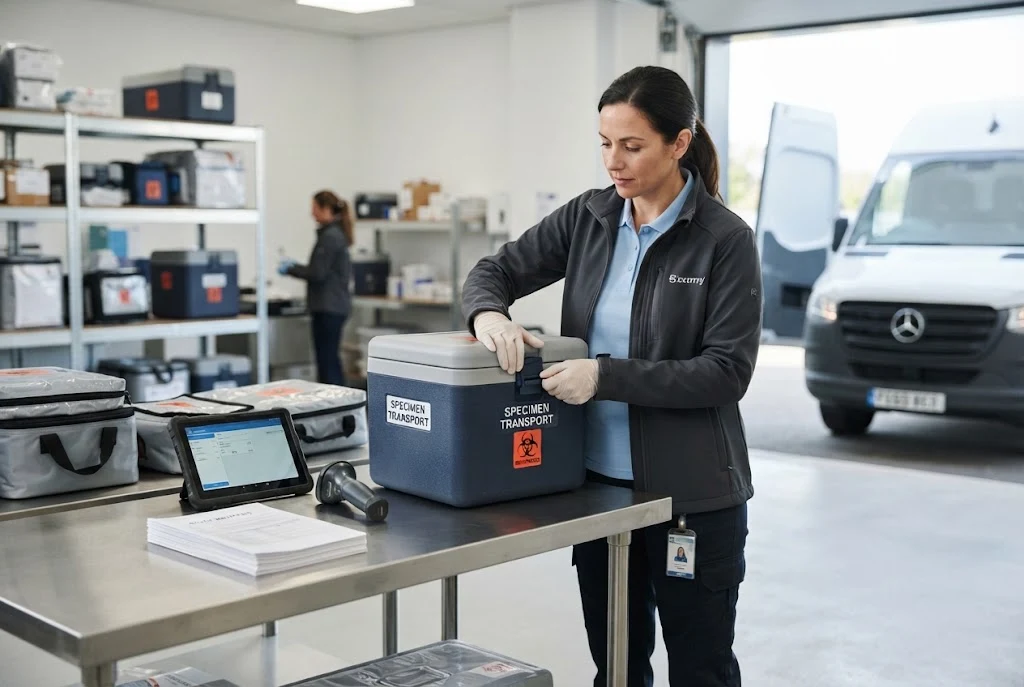
Unlike conventional delivery work, laboratory logistics can involve stricter handling procedures and greater accountability. A contractor may need to follow defined pickup windows, maintain accurate records, protect the integrity of transported materials, and communicate promptly when conditions change.
For individuals interested in independent work, this field can combine transportation with healthcare-related logistics while offering the flexibility associated with contractor arrangements. However, success requires more than simply having a vehicle and accepting delivery assignments.
What Is a Lab Logistics Independent Contractor?
A lab logistics independent contractor is a self-employed service provider who performs transportation or logistics tasks for laboratories, healthcare organizations, diagnostic services, medical networks, or logistics companies under a contract or service arrangement.
The exact work depends on the client. Some contractors may transport laboratory specimens between collection locations and testing facilities, while others may move supplies, equipment, paperwork, or other approved materials between facilities.
The contractor is generally responsible for meeting agreed service requirements rather than functioning as a traditional employee. That can mean managing schedules, maintaining a suitable vehicle, tracking mileage and expenses, communicating with dispatchers, and keeping required documentation organized.
This role fits into the wider modern logistics ecosystem, where timing, coordination, and reliable movement of goods are essential.
Why Laboratory Logistics Is Different
Laboratory transportation can require a higher level of procedural discipline than ordinary package delivery. Depending on the material and client requirements, contractors may need to follow instructions involving packaging, labeling, temperature control, documentation, pickup verification, and delivery confirmation.
Specimens can also be time-sensitive. A delayed or improperly handled shipment may affect downstream laboratory processes, making punctuality and communication especially important.
Current laboratory transportation job postings illustrate the importance of specimen handling, route planning, time management, attention to detail, and infection-control awareness.
For this reason, contractors should never assume that general courier experience automatically satisfies the requirements of a laboratory client. Every client may establish its own procedures, training requirements, service levels, and compliance expectations.
Common Responsibilities
The responsibilities of a lab logistics independent contractor vary according to the contract, but common activities can include:
- Collecting approved materials from designated locations
- Transporting specimens or supplies between facilities
- Following assigned pickup and delivery schedules
- Checking manifests, labels, or documentation
- Maintaining accurate pickup and delivery records
- Communicating with dispatchers and facility staff
- Following client handling and safety procedures
- Monitoring routes and adjusting to traffic or operational changes
- Maintaining vehicle readiness
- Reporting delays, discrepancies, or incidents promptly
- Protecting confidential information encountered during assignments
The contractor may also need to document mileage, fuel, tolls, maintenance, insurance, and other business expenses.
Specimen Transportation and Chain of Custody
One of the most important concepts in laboratory logistics is accountability. When a specimen moves from a collection point to a laboratory, there needs to be a clear process for establishing where it came from, who handled it, when it was collected, when it was transferred, and when it reached the intended destination.
Depending on the operation, this may involve manifests, electronic scanning, timestamps, signatures, tracking systems, or other documentation.
A contractor should treat every assignment according to the client’s established procedures. The objective is not simply to move an item from one address to another. The objective is to complete the movement accurately while preserving the required documentation and handling standards.
This makes attention to detail a major professional advantage for independent contractors in this field.
Skills That Can Help You Succeed
Reliability
Healthcare and laboratory operations depend on predictable transportation. Contractors should be able to arrive within agreed windows and communicate quickly if a problem threatens the schedule.
Route Planning
Strong route planning can reduce unnecessary mileage, fuel consumption, and delays. Contractors should understand traffic patterns, facility locations, parking restrictions, and realistic travel times.
Attention to Detail
Names, labels, manifests, timestamps, quantities, and destinations must be checked carefully. A small administrative error can create unnecessary operational problems.
Communication
Independent contractors frequently interact with dispatchers, laboratory personnel, healthcare staff, facility managers, and other logistics professionals. Clear communication helps resolve issues before they become larger problems.
Time Management
Multiple pickups and deliveries may need to be completed within specific windows. Effective time management is therefore essential.
Workers interested in broader logistics careers can also explore order selector and warehouse logistics opportunities to understand another part of the supply chain.
Vehicle Requirements
The appropriate vehicle depends on the type of work and the contractor’s client. Some assignments may require only a reliable passenger vehicle, while others may involve specialized transportation requirements.
Before accepting a contract, confirm the expected vehicle type, cargo requirements, mileage expectations, parking arrangements, equipment requirements, and any special handling procedures.
Vehicle reliability should be treated as a business priority. Preventive maintenance, tire condition, fluid checks, insurance, and emergency planning can reduce the risk of missed pickups.
Compliance and Training Considerations
Laboratory logistics can involve regulated or sensitive materials, so contractors should never rely on informal assumptions about what they are permitted to transport.
Depending on the assignment, clients may require specific training, identification, background checks, documentation, protective equipment, or handling procedures. Requirements can also vary according to the material being transported and the applicable regulations.
Before beginning work, contractors should ask the client exactly what training and documentation are required. If an assignment involves regulated materials, the contractor should understand the applicable rules and follow the client’s established procedures.
How to Find Lab Logistics Contracts
Finding suitable contracts requires a targeted search because the job may appear under several different titles. Instead of searching only for “lab logistics independent contractor,” consider related terms such as:
- Laboratory courier contractor
- Medical courier independent contractor
- Specimen transport driver
- Laboratory courier
- Healthcare logistics contractor
- Medical delivery contractor
- Specimen transportation jobs
- Diagnostic courier jobs
- Healthcare delivery driver
- Laboratory logistics specialist
Contractors can also approach medical courier companies, laboratory networks, healthcare organizations, diagnostic providers, and specialized logistics firms directly.
Those interested in wider logistics opportunities can compare this career path with modern supply chain and logistics operations.
How to Evaluate a Contract
Not every independent contractor opportunity is equally profitable. Before accepting an assignment, calculate the actual economics of the contract rather than focusing only on the advertised payment.
Important factors include:
- Payment per route or assignment
- Total expected mileage
- Fuel costs
- Vehicle maintenance
- Insurance expenses
- Tolls and parking
- Unpaid waiting time
- Administrative time
- Required equipment
- Taxes and other business expenses
A route that appears attractive at first may become less profitable after accounting for empty return miles, traffic, fuel, maintenance, and unpaid time.
For contractors considering other self-employment models, business investment and partnership considerations can also provide broader context when evaluating long-term opportunities.
Building a Profitable Route Strategy
Efficiency is one of the biggest opportunities for independent contractors. A well-planned route can allow more productive assignments without necessarily increasing total working hours.
Start by mapping regular pickup and delivery locations. Identify geographic clusters, recurring schedules, high-traffic periods, and locations where parking or access can create delays.
When possible, look for contracts that reduce empty mileage. A contractor who drives a long distance without compensation between assignments may lose a significant portion of the revenue generated by the route.
Tracking actual operating costs over several weeks can reveal which contracts and routes are genuinely profitable.
Technology for Laboratory Logistics
Technology can simplify many parts of independent logistics work. Depending on the client, contractors may use GPS navigation, route-planning applications, digital manifests, barcode scanners, proof-of-delivery systems, communication platforms, and mileage-tracking tools.
Technology can also improve documentation. Digital records make it easier to verify completed stops, identify delays, calculate mileage, and organize information for invoicing or accounting.
However, contractors should use only systems approved or required by the client when handling sensitive operational information. Convenience should never come at the expense of security or compliance.
Independent Contractor vs. Employee
The independent contractor model can offer greater control over how a person structures their business, but it also transfers additional responsibilities to the worker.
An employee may receive employer-provided benefits, payroll processing, and company-managed equipment or expenses. An independent contractor may instead be responsible for taxes, insurance, vehicle costs, accounting, equipment, maintenance, and business administration.
That difference should be considered carefully before accepting a contract.
Workers exploring multiple career models can also review travel-focused healthcare career opportunities for comparison.
Creating a Professional Contractor Profile
A strong contractor profile should communicate reliability and operational competence rather than simply stating that you are available to drive.
Highlight relevant experience such as:
- Courier or delivery work
- Healthcare or laboratory transportation
- Route planning
- Time-sensitive deliveries
- Inventory handling
- Documentation and record keeping
- Customer communication
- GPS and logistics technology
- Safety training
- Clean driving history where applicable
If you are new to laboratory logistics, emphasize transferable skills from transportation, warehouse operations, healthcare support, customer service, or other detail-oriented environments.
Growing Beyond One Contract
A successful contractor should avoid depending entirely on one source of work when diversification is practical and contract terms allow it.
As experience grows, contractors may consider additional logistics services, expanded service areas, additional clients, or eventually building a small delivery operation. The goal should be sustainable growth rather than simply accepting as many routes as possible.
Understanding broader distribution models can help contractors see where their services fit within the supply chain. Resources covering supply chain distribution and global shipping logistics provide useful context.
Questions to Ask Before Signing a Contract
Before accepting a laboratory logistics contract, ask detailed questions about the relationship and the work.
- What materials will be transported?
- What are the required pickup and delivery windows?
- How is compensation calculated?
- Is mileage reimbursed separately?
- Who pays tolls and parking costs?
- What vehicle requirements apply?
- What training is mandatory?
- What documentation must be completed?
- How are delays handled?
- What happens if a pickup is canceled?
- Who provides packaging or transportation equipment?
- What insurance coverage is required?
- How frequently are contractors paid?
- Are there minimum route volumes or guaranteed assignments?
Clear answers can help prevent disputes and allow you to calculate the real value of the opportunity.
Managing the Business Side
Independent contracting requires more than completing routes. You are also operating a small business.
Keep organized records of income, mileage, fuel, maintenance, insurance, equipment, tolls, parking, and other legitimate business expenses. Separate personal and business finances where practical, and consult a qualified tax professional about the rules that apply to your situation.
Good administration can make it much easier to determine whether a contract is actually profitable.
Contractors interested in broader business development can also explore business collaboration and investment concepts as their operations develop.
Challenges to Expect
Laboratory logistics can be rewarding, but it is not without challenges. Traffic, unexpected delays, facility closures, vehicle problems, changing schedules, documentation errors, and communication issues can all affect a route.
The best contractors prepare for these situations instead of assuming every day will run exactly according to plan.
Maintaining emergency contacts, allowing realistic travel time, keeping the vehicle properly maintained, and communicating early when a problem occurs can significantly improve reliability.
Is Lab Logistics Contracting Right for You?
This career path may be a strong fit for someone who enjoys driving, structured work, logistics, time-sensitive assignments, and independent responsibility.
It may be less suitable for someone who wants a completely remote job or prefers work with little schedule pressure. Laboratory logistics is generally connected to physical transportation, and some assignments may require strict timing or specialized handling.
The opportunity becomes more attractive when the contractor understands the operational requirements, calculates expenses accurately, and chooses contracts that align with their available vehicle, schedule, service area, and business goals.
Final Thoughts
A lab logistics independent contractor can play an important role in the movement of laboratory and healthcare materials. The work combines transportation, organization, communication, time management, and careful adherence to client procedures.
Success depends on much more than completing deliveries. Contractors need reliable vehicles, efficient routes, accurate records, strong communication, appropriate training, and a clear understanding of their operating costs.
For people who approach the field as a genuine business rather than simply a driving opportunity, laboratory logistics can become a specialized path within the broader transportation and supply chain industry. Start by understanding the requirements of each contract, calculate the real costs, protect service quality, and build your reputation around reliability and accuracy.